
Abbreviations
UVAS: University of Veterinary and Animal Sciences
NSAIDs: Nonsteroidal anti-inflammatory drugs
Introduction
Zebras belong to the genus Equus and include four species: the plains zebra (Equus quagga), Cape mountain zebra (Equus zebra), Hartmann's mountain zebra (Equus hartmannae), and Grevy's zebra (Equus grevyi) [ 1 ]. The most geographically widespread specie is the plains zebra, also known as Burchell's or common zebra, ranging from eastern South Africa to southern Ethiopia and South Sudan [ 1 ]. Despite their adaptability, human encroachment, habitat degradation, and competition with livestock pose risks to plains zebras, which has resulted in a drop in their population, leading to their classification as near threatened and raising conservation concerns [ 1 ].
Mares usually reach puberty between 1 and 3 years of age [ 2 , 3 ], with first estrus occurring around 2–3 years. The gestation period ranges from 361-396 days [ 4 ], and first foaling occurs at 3-4 years of age [ 3 ]. Parturition commonly occurs during the early morning hours [ 5 ]. Although, dystocia is relatively rare in mares, it represents a true veterinary emergency and needs to be treated promptly due to risks to both the mare and fetus [ 6 ]. The most frequent cause of dystocia in mares is malposition from normal alignments, especially postural abnormalities, while anterior presentation, dorsal position, extension of the limbs and head posture are normal [ 7 ]. Approximately 99% of parturition occurs in the anterior presentation. Williams [ 8 ] and Noakes, Parkinson [ 9 ] reported that there is 1.1 % incidence of dystocia in equines. This report describes a case of dystocia in a four-year-old captive plains zebra mare (Equus quagga) housed at Lahore Zoo, Punjab, Pakistan. In thai case, dystocia resulted from fetal malposition, a commom cause in equids, leading to a challenging condition but ultimately successful manual correction was performed.
Case Presentation
The administration of Lahore Zoo requested assistance from the University of Veterinary and Animal Sciences (UVAS), Lahore, Pakistan, to manage a suspected case of dystocia in a captive zebra. A clinical team from UVAS arrived at the zoo (90 Mall Road, Lahore, Punjab, Pakistan; 31.556°N, 74.325°E) in the afternoon. Feeding and drinking of the animal were compromised. The affected animal was a four-year-old plains zebra (Equus quagga) mare exhibiting symptoms of prolonged labor. According to zoo staff, the mare's water broke earlier that morning but no progress toward delivery had occurred by afternoon.
This was the mare's first parturition. Upon physical examination, the animal appeared to be standing but dull, depressed, and exhibited a staggering gait. Vaginal examination indicated completion of the first stage of laber, but the second stage had been prolonged for 10-12 hours without progress. The mare was struggling continuously. Clinical signs included sacrosciatic ligaments relaxation, vulvar edema, and ruptured fetal membranes. During the initial obstetrical assessment, fetal viability, orientation, and condition of the birth canal were evaluated. The fetus was confirmed dead based on the absence of reflexes such as suckling and pedal response. Detailed palpation revealed an anterior longitudinal presentation, dorsopubic position, and multiple postural defects, including carpal flexion of both forelimbs and severe lateral deviation of the head. The diagnosis of dystocia related to fetal malposition was confirmed by these abnormalities.
Obstetrical procedure and treatment
General anesthesia was administered via remote darting (Figure 1. A) using a Teleinject Vario 4 system. Butorphanol (0.01 mg/kg; total 120 mg) and detomidine (0.1 mg/kg; total 50 mg) were administered for induction. The mare was kept under anesthesia after sedation with intravenous boluses of xylazine (500 mg) and ketamine (1,500 mg) [ 10 ]. dart placement targeted the heavy thigh musculature using an 18-gauge, 1.5-inch specialized needle [ 11 ]. Because of the low musculature and risk of injury, darting in the thoracic or abdominal regions was avoided. The darting area was inspected for rough ground, pools of water, debris and fencing. To reduce the risk of capture myopathy, the procedure was performed in a quiet, enclosed stall free of obstacles. After the dart was fired (Figure 1. A), the dart stuck effectively in the animal's muscle. Sedation took effect within 20 to 25 minutes, and the dart successfully discharged and detached appropriately. The mare was examined for external abnormalities such as sarcoids [ 12 ], hoof deformities, mucous membrane state, and oral health prior to the obstetrical intervention. Additional ketamine boluses (100–200 mg IV) were administered as needed to prolong the anesthesia [ 10 ]. Intravenous glucose-saline (1,500 ml) was provided to address dehydration and support energy requirements.
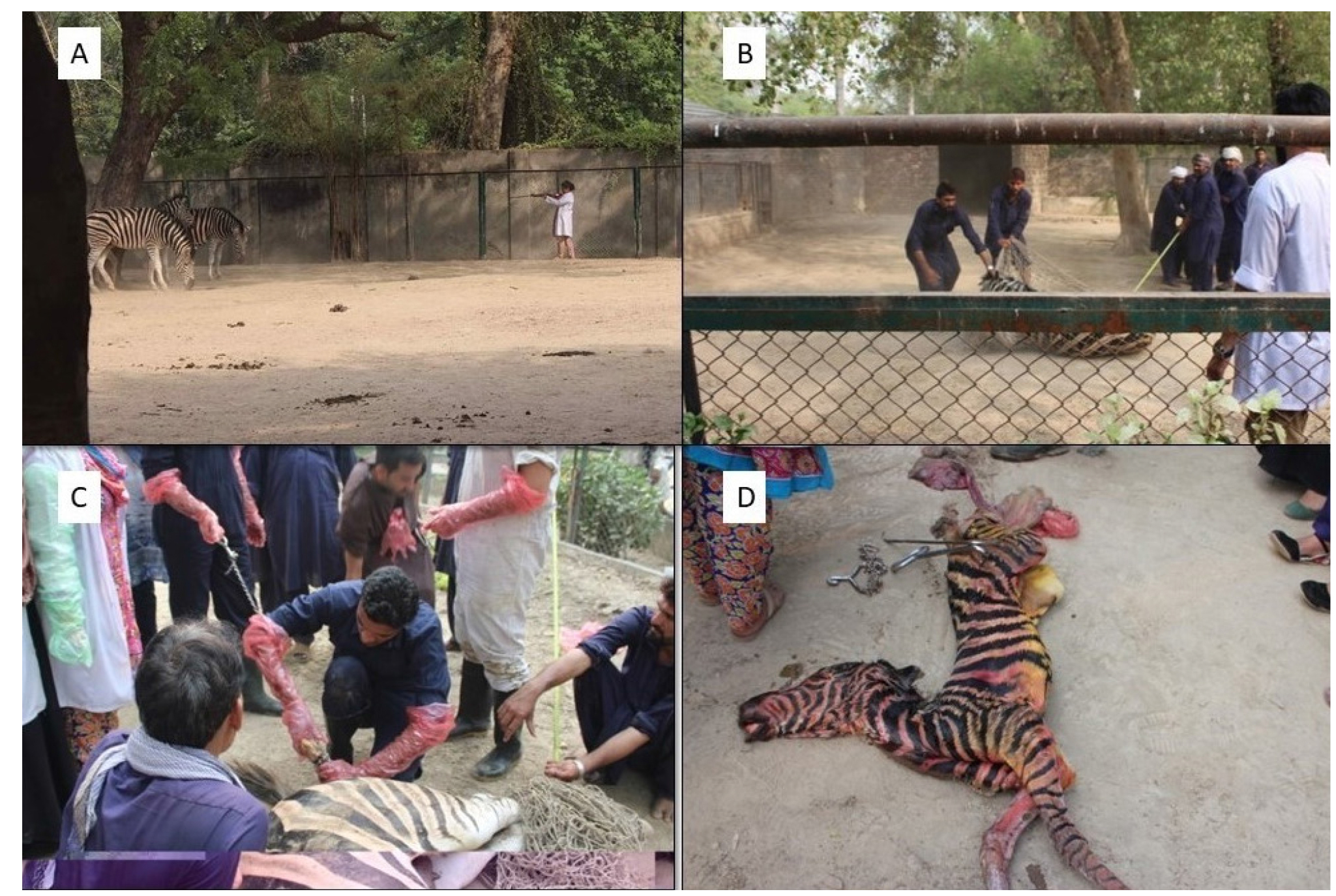
Figure 1.Stages of Dystocia Management in a Zebra (Equus quagga)(a) Chemical immobilization (darting) using a remote injection system; (b) Physical restraint for clinical examination; (c) Manual forced extraction of the malpositioned fetus; (d) Outcome showing the dead foal post-extraction.
Obstetrical correction began with mutation to address the fetal postural defects. Both forelimbs were flexed at the carpal joints. To provide additional working space, the fetus was gently repelled into the uterus. Flexion of the left carpus was converted to fetlock flexion. The proximal metacarpus was oriented laterally, and the hoof was manually cupped and rotated medially. An obstetrical chain (Figure 1. C) was used to secure the limb once it had been stretched. The right limb was corrected using the same technique. Both legs were pushed back into the birth canal. The head showed severe rightward deviation. A soft rope was used to snare the head at the mandible, a gentle repulsion allowed improved access. Controlled upward traction realigned the head, after which both limbs were simultaneously tractioned. After some time, legs and head were correctly positioned on the pelvic floor. Copious amounts of obstetrical lubricant was applied to minimize trauma or reduce the risk of uterine rupture by rotating the fetus around its longitudinal axis into the dorsosacral position. Final traction was applied in a horizontal, downward, and posterior direction toward the hock joints (Figure 1. C). After approximately two hours, the fetus was successfully delivered vaginally. The foal weighed 35 kg and displayed a typical neonatal zebra coat pattern of brown and white (Figure 1. D).
The mare received supportive therapy during recovery, which included a second 1,500 ml glucose-saline infusion and multivitamins (Amivicom, 30 ml). Ceftiofur hydrochloride (1.1–2.2 mg/kg; total 7 ml) was administered to prevent the infection. Systemic non-steroidal anti-inflammatory drugs (NSAIDs) were administered to treat pain (5 ml, 2–4.4 mg/kg). The mare regained the ability to stand without assistance roughly four hours after treatment began. Post procedure care included continued administration of phenylbutazone (2.2–4.4 mg/kg IV every 12 hours for 48–96 hours, then decreased and continued for 5 days) and ceftiofur (1.1-2.2 mg/kg, for 5 days). An antispasmodic drug (Spasfon) was administered as a preventative measure since lateral recumbency during sedation carries a risk of colic.
Dystocia in mare is less common than in other domestic animals, but when it occurs, it is a serious obstetrical emergency that needs to be treated immediately [ 6 , 13 ]. There is less documentation regarding dystocia in mares [ 14 ]. The most common cause of dystocia in equines is postural abnormality, especially lateral deviation of the head. Although other presentation and positional abnormalities can also contribute, they are observed less frequently [ 9 ]. Fetotomy is frequently necessary in these situations in order to protect the mare's life and future reproductive potential [ 9 ]. Despite its effectiveness, cesarean section poses additional risks, including decreased post-surgical fertility, uterine laceration, retained fetal membranes, laminitis, metritis, and peritonitis [ 6 , 15 ]. An assisted vaginal delivery using mutation, repulsion, and controlled extraction may be preferable to cesarean section when fetal viability is lost and surgical facilities are unavailable [ 6 , 16 ]. Furthermore, the availability of surgical facilities, fetal state, gestational age, and the veterinary team's experience must all be taken into account while making decisions. In equine, assisted vaginal delivery or fetotomy is often favored over cesarean section due to lower risks of mare mortality, retained placenta and reduced fertility [ 17 ].
In the present case, multiple fetal abnormalities, including dorsopubic positioning, bilateral carpal flexion, and extreme lateral displacement of the head, resulted in dystocia. Despite the complexity of dystocia caused by these combined abnormalities, resolution was achieved without recourse to cesarean section or fetotomy. Successful manual correction was facilitated by timely intervention, accurate diagnosis, appropriate sedation, and skilled obstetrical manipulation. The use of remote dart administered anesthesia was particularly important given the wildlife context and was well tolerated without significant complications. To the authors' knowledge, represents the first documented case in Pakistan of dystocia in a captive plains zebra successfully managed via assisted vaginal delivery. No post delivery complications such as retained fetal membranes, vaginal lacerations, or laminitis were observed. This case highlights the potential of non-surgical management of complex dystocia in wild equids under field conditions and provides practical guidance for wildlife veterinarians confronted with similar scenarios.
Conclusion
This case demonstrates that even complex dystocia in zebras resulting from fetal malposition can be successfully treated through mutation and controlled extraction without the need for a fetotomy or cesarean section. The positive outcome was largely dependent on early diagnosis, appropriate anesthesia, skilled obstetrical manipulation, and attentive supportive care. Beyond adding to the limited literature on dystocia in wild equids, this report provides useful guidance for veterinarians managing similar cases in wild equines in field conditions, this article contributes to the scant literature on equine dystocia.
Authors' Contributions
The case of this mare was first attended by M.U.M., S. Ali, M.A. and A.S. after thorough obstetrical examination it was decided to perform manual correction and assisted vaginal delivery. Consequently, M.U.M., M.A. and S. Akram conceived the idea of reporting the procedure and findings for this case. M.U.M., S. Akram and M.A. equally contributed on this case report–research; manuscript drafting; M.U.M. and A.S. equally contributed on patient care and monitoring. All authors have checked the final draft.
Acknowledgements
The authors extend their sincere gratitude to the administration of Lahore Zoo for their cooperation, provision of necessary resources and timely communication during this emergency case. The successful completion of the obstetrical intervention and safe handling of the animal were made possible by their proactive help. Without their support and dedication to animal welfare, this case could not have been resolved successfully.
Conflict of interest
The authors declare that there is no conflict of interest.
References
- King S, Moehlman P. Equus quagga. The IUCN Red List of Threatened Species 2016: e. T41013A45172424. 2021.DOI
- Klingel H. Notes on the biology of the plains zebra Equus quagga boehmi Matschie. African Journal of Ecology. 1965;3(1):86-8.DOI
- Smuts G. Reproduction in the zebra stallion (Equus burchelli antiquorum) from the Kruger National Park. African Zoology. 1976;11(1):207-20.DOI
- Nunez CM, Asa CS, Rubenstein DI. Zebra reproduction. Equine reproduction 2nd ed Wiley-Blackwell, Ames, IA2011. p. 2851-65.DOI
- Wackernagel H. GRANT'S ZEBRA, Equus burchelli boehmi, AT BASLE ZOO-A CONTRIBUTION TO BREEDING BIOLOGY. International Zoo Yearbook. 1965;5(1):38-41.DOI
- Freeman D, Hungerford L, Schaeffer D, Lock T, Sertich P, Baker G, et al. Caesarean section and other methods for assisted delivery: comparison of effects on mare mortality and complications. Equine veterinary journal. 1999;31(3):203-7.DOI
- Freeman D, Hungerford L, Schaeffer D, Lock T, Sertich P, Baker G, et al. Caesarean section and other methods for assisted delivery: comparison of effects on mare mortality and complications. Equine veterinary journal. 1999;31(3):203-7.DOI
- Williams WL. Veterinary obstetrics: The author; 1917.
- Noakes DE, Parkinson TJ, England GC. Veterinary reproduction and obstetrics 2009.DOI
- Wiedner EB, Lindsay WA, Isaza R. Management of zebras and zebra hybrids (zebroids). Compend Contin Educ Vet. 2012;34(9):E4. PMID: 23705207.
- Allen JL. Immobilization of Hartmann's mountain zebras (Equus zebra hartmannae) with carfentanil and antagonism with naltrexone or nalmefene. Journal of Zoo and Wildlife Medicine. 1994:205-8.DOI
- Bergvall KE. Sarcoids. Veterinary Clinics: Equine Practice. 2013;29(3):657-71.DOI
- Lu KG, Barr BS, Embertson R, Schaer BD. DystociaA true equine emergency. Clinical Techniques in Equine Practice. 2006;5(2):145-53.DOI
- Jeffcott L, Rossdale P. A critical review of current methods for induction of parturition in the mare. Equine veterinary journal. 1977;9(4):208-15.DOI
- Carluccio A, Contri A, Tosi U, De Amicis I, De Fanti C. Survival rate and short-term fertility rate associated with the use of fetotomy for resolution of dystocia in mares: 72 cases (19912005). Journal of the American Veterinary Medical Association. 2007;230(10):1502-5.DOI
- Walters K. Obstetrics: Mutation, Forced Extraction, and Fetotomy. Bovine Reproduction2021. p. 608-18.DOI
- Maaskant A, De Bruijn C, Schutrups A, Stout T. Dystocia in Friesian mares: Prevalence, causes and outcome following caesarean section. Equine Veterinary Education. 2010;22(4):190-5.DOI

